EOL's actual evolving record. Each monthly information state preserves the signals observed, how the six-stage assessment changed, and whether the forecast held or adjusted.
Signal Tracker · September 2026
Finding Signals in the Noise
AI, robotics, and automation generate a constant stream of new information. Signal Tracker records how EOL separates meaningful signals from that noise, how those signals change our assessment of the technology-to-labor transition, and when the evidence becomes strong enough to change an employment forecast.
The objective is not to make forecasts move more often. It is to get the signals right.
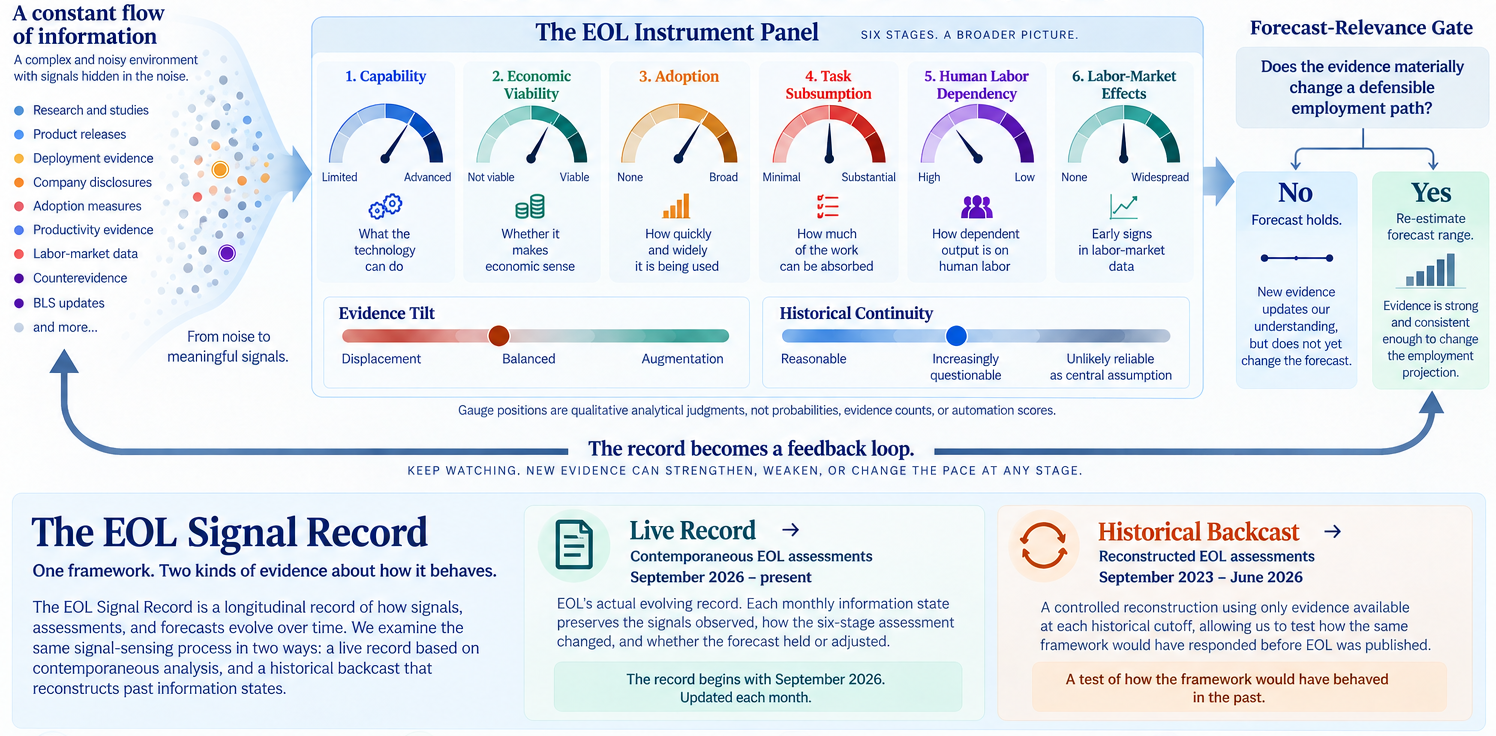
How Signal Tracker works
New information is screened for meaningful signals. Those signals update six qualitative stages: Capability, Economic Viability, Adoption, Task Subsumption, Human Labor Dependency, and Labor-Market Effects.
Evidence Tilt and Historical Continuity summarize the broader picture. The Forecast-Relevance Gate then asks whether the evidence materially changes a defensible employment path. The forecast either holds or is re-estimated, and the record keeps watching.
The EOL Signal Record
One framework. Two kinds of evidence about how it behaves.
The EOL Signal Record is the longitudinal research record behind Signal Tracker. It follows how signals, assessments, and forecasts evolve over time.
A controlled reconstruction using only evidence available at each historical cutoff, allowing us to test how the same framework would have responded before EOL was published.
Live Record
The contemporaneous EOL record starts here.
September 2026 is EOL's first Live Record information state. Each subsequent monthly assessment will be added without rewriting the analytical states that came before it.
OCT2026Next assessment
NOV2026Future assessment
DEC2026Future assessment
→
What each monthly Live Record state preservesMaterial signalsSix gauge statesEvidence TiltHistorical ContinuityForecast held or adjustedForecast Bridge rationale
What the Live Record showsThe record begins here.
September 2026 establishes EOL's first contemporaneous information state. As monthly observations accumulate, this section will summarize what the Live Record is showing about the pace, direction, persistence, and forecast relevance of signals across the 20 occupations.
Explore an occupation
Watch the evidence and forecast evolve.
The same viewer spans the Historical Backcast and the Live Record. Move through time to see the gauge states recorded for each information cutoff, the evidence and signals behind changes, and whether the employment forecast held or adjusted.
RECONSTRUCTED RECORDLIVE RECORD
BEGINS
BEGINS
Reconstructed information state
Software Developers
Selected information state2023 Q3Evidence cutoff Sep. 30, 2023
Forecast-Relevance Gate
Signals and driversWhat changed at this information state?Select any gauge above to see the evidence-based rationale recorded for that information state.
Employment outlookHow the forecast evolved
EOL 2035 rangeMidpointForecast adjustment
Historical Backcast
The reconstructed EOL record starts here.
Reconstructed EOL assessments · September 2023 → June 2026
EOL was first published in September 2026. To test how the framework would have responded before then, we reconstructed quarterly information states beginning in September 2023. These are not forecasts that were actually published at those dates; they show what the EOL framework would have concluded using evidence available by each historical cutoff.
Guarding against hindsight
Reconstructing a historical assessment after later events have occurred creates an obvious risk: knowledge of what happened afterward can influence how earlier evidence is interpreted. We therefore made an explicit effort to quarantine each historical information state. Evidence was screened by publication date, later information was excluded from the assessment, and the evidence review was completed before the employment forecast was reconsidered.
No retrospective exercise can guarantee that an analyst has completely erased knowledge acquired later. The backcast does not make that claim. These controls were designed to reduce hindsight and foreknowledge bias as much as practicable and to make the reconstruction disciplined, reproducible, and auditable.
How the backcast was constructed +
Use only information available at the cutoff. Each quarterly assessment was rebuilt from evidence that could be established as publicly available by that date. Later evidence was excluded.
Assess the evidence before revisiting the forecast. For every occupation, EOL first evaluated what the available evidence implied across the same six stages used today. Only after that assessment was completed did we ask whether the evidence justified changing the 2030 or 2035 employment range.
Preserve the BLS information available at the time. A BLS projection remained the structural reference until BLS actually published a new projection release. When a new release arrived, EOL treated it as a change in the structural starting point, not as evidence that technology itself had suddenly accelerated.
Do not manufacture movement. If the evidence did not materially change an occupation's assessment, its gauges and forecast were allowed to remain unchanged.
Check the reconstruction. Annual September states were reconciled to separately constructed annual anchors, and the complete quarterly series received an independent QA review.
The resulting record contains 20 occupations across 12 quarterly information states. BLS structural updates remain distinguishable from technology-driven forecast changes.
What the Historical Backcast shows
Responsive assessment, selective forecast change.
The historical test lets us examine how often new information changed EOL's understanding of an occupation, how often that change was strong enough to alter an employment range, and how the timing compared with changes in the structural BLS reference.
Assessment updateForecast changeBLS rebase
One longitudinal record
Historical Backcast and Live Record. One analytical language.
The seam is permanent and explicit. Historical Backcast observations remain distinguishable from Live Record information states produced contemporaneously.
Sep 2023 → Jun 2026Historical backcast
Quarterly reconstructed information states.
SEP
2026
2026
Sep 2026 →Live Record
Monthly contemporaneous information states, preserved as recorded.
Learning over time
The record becomes a feedback loop.
As the Live Record grows, EOL can examine which early signals persisted, which propagated through later stages, and whether forecast holds or adjustments remained defensible.
Was it confirmed, strengthened, qualified, reversed, or still unresolved?
Did capability become adoption, task absorption, lower Human Labor Dependency, or labor-market effects?
Was holding or changing the range supported by what came next?
Use recurring successes and misses to improve signal classification and judgment prospectively.
The historical backcast evaluates responsiveness, selectivity, and chronology. It does not establish eventual forecast accuracy, and retrospective reconstruction is not equivalent to forecasts published contemporaneously.